


Modernizing the built environment
- Thomas Kwan
- 21 Sep 2026
- 7 min read
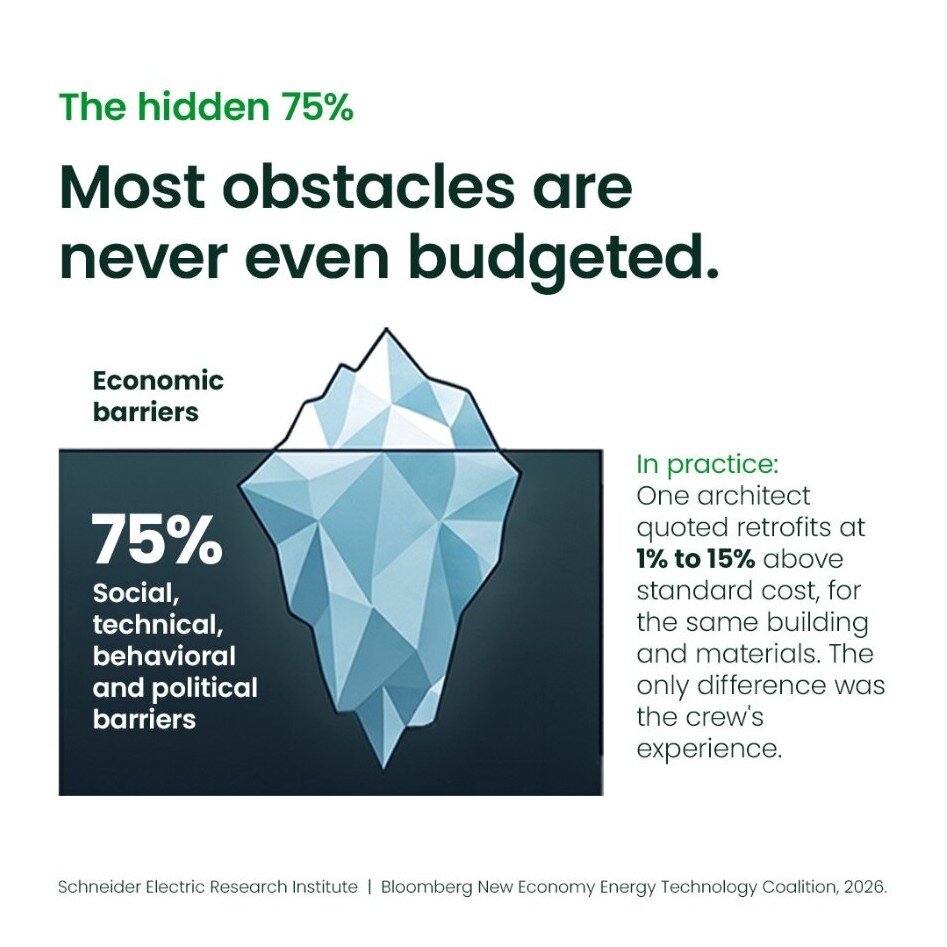
The next constraint on U.S. building modernization is not technology. It's the market's ability to deploy it at scale. Research from the Schneider Electric Research Institute and Boston University's Institute for Global Sustainability, drawing on 60 practitioner interviews across Boston and Phoenix, finds that three-quarters of the obstacles practitioners describe have no line item in a standard cost-benefit model. A retrofit that one Massachusetts architect prices between one and 15 percent above conventional cost is not pricing a harder building. It is pricing a market that is not yet equipped to do the work at scale: the trained subcontractor base, the underwriting template, and the review protocol that lets a jobsite move without incident.
Related
Why Decisions Made Today Last a Century
Modernizing the Built Environment:Upfront cost isn't the real barrier to building modernization. A lack of institutional capacity is. Hear experts from Boston University, the University of Arizona, and the Schneider Electric Research Institute on why the buildings we modernize today will shape the next century.
A Massachusetts architect prices the cost of retrofitting an older building at anywhere from 1% to 15% above conventional construction. That 14-percentage-point spread probably sounds like a typo. It actually just tracks how many times the project team has built the system before (right now, that number varies wildly by team).
The biggest constraint on U.S. building decarbonization isn't technology. It's the market's ability to deploy it at scale. Research from the Schneider Electric Research Institute and Boston University’s Institute for Global Sustainability finds that three-quarters of the obstacles practitioners cite have no line item in a standard cost-benefit model.
Heat pumps, smart controls, mass timber, and building performance standards are part of every architect’s vocabulary. The trained installers, underwriting templates, permitting protocols, and insurance products needed to deploy them at volume are still catching up.
The stakes are large. Buildings produce about 37% of global greenhouse gas emissions, and U.S. commercial and residential buildings use 36% of the country’s energy and 75% of its electricity.
The findings draw on four peer-reviewed studies (Energy & Buildings, Nature Communications, Building and Environment, and Urban Climate), more than 880 sources, 60 expert interviews across Boston and Phoenix, and a case study from the Bloomberg New Economy Energy Technology Coalition.
75%
of the obstacles building practitioners cite have no line item in a standard cost-benefit model
1% to 15%
retrofit cost premium quoted by one Massachusetts architect, depending on the team’s experience with the system
90%
drop in energy consumption at Credit Human’s San Antonio headquarters versus its 2 prior buildings
Related
Download the visual summary: Constraints of building modernizationView a visual summary of the non-technological barriers to decarbonizing modern buildings.
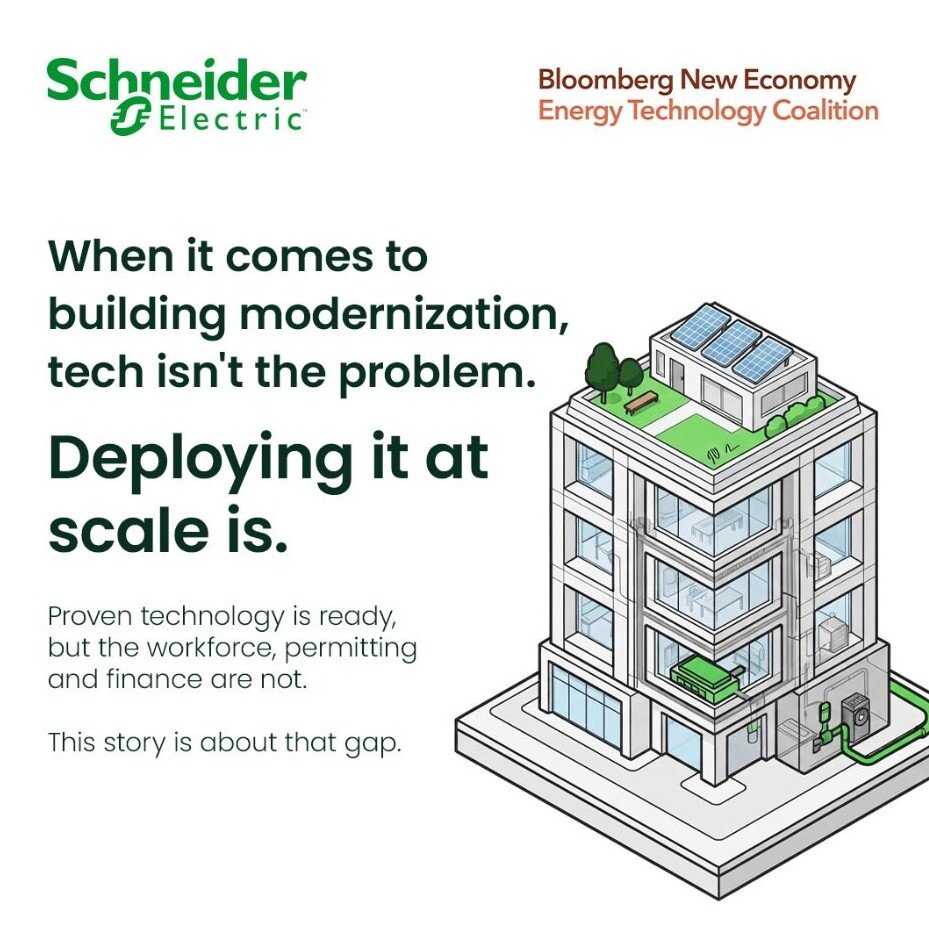
Market capacity, not technology, constrains building modernization
Proven technologies like heat pumps, mass timber, and smart controls exist, but the workforce, financing structures, permitting protocols, and insurance markets have not kept pace.
Market capacity, not technology, constrains building modernization
Proven technologies like heat pumps, mass timber, and smart controls exist, but the workforce, financing structures, permitting protocols, and insurance markets have not kept pace.
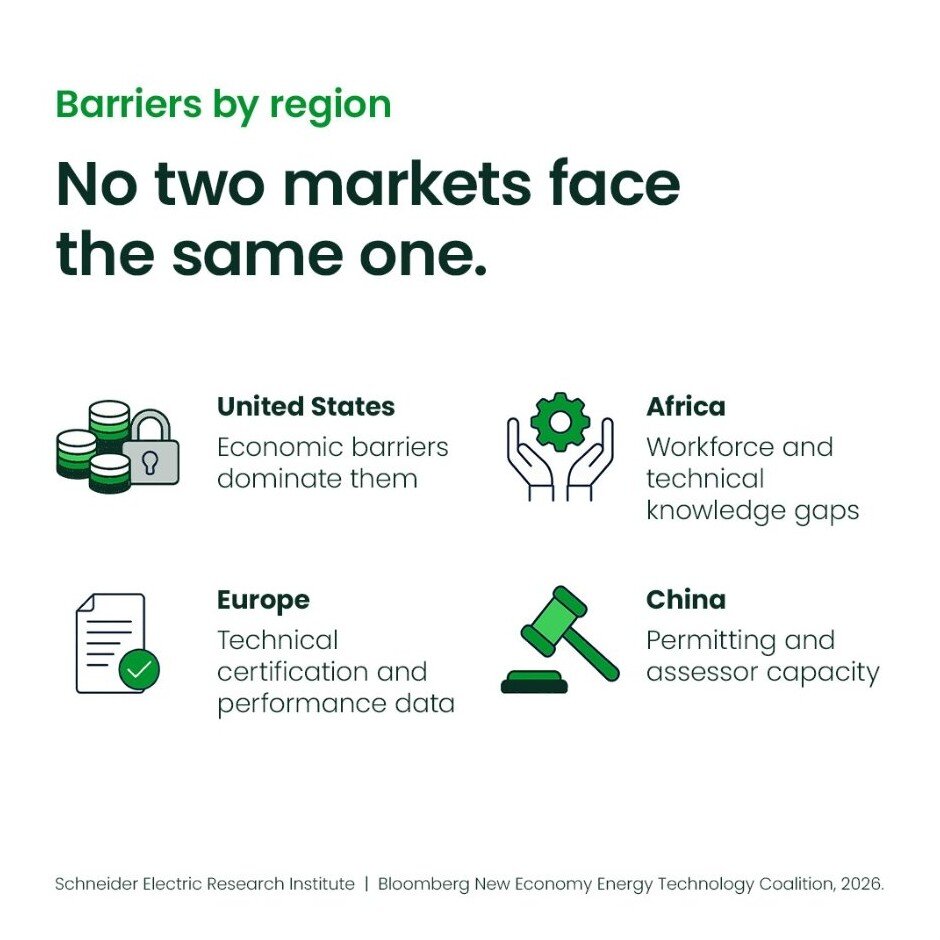
Market capacity, not technology, constrains building modernization
Proven technologies like heat pumps, mass timber, and smart controls exist, but the workforce, financing structures, permitting protocols, and insurance markets have not kept pace.
Market capacity, not technology, constrains building modernization
Proven technologies like heat pumps, mass timber, and smart controls exist, but the workforce, financing structures, permitting protocols, and insurance markets have not kept pace.
Market capacity, not technology, constrains building modernization
Proven technologies like heat pumps, mass timber, and smart controls exist, but the workforce, financing structures, permitting protocols, and insurance markets have not kept pace.
When practitioners say a low-carbon building costs more, they’re usually describing a gap with a paper trail: an installer the market hasn’t trained, an underwriter who hasn’t seen the equipment perform, a code official without a review protocol.
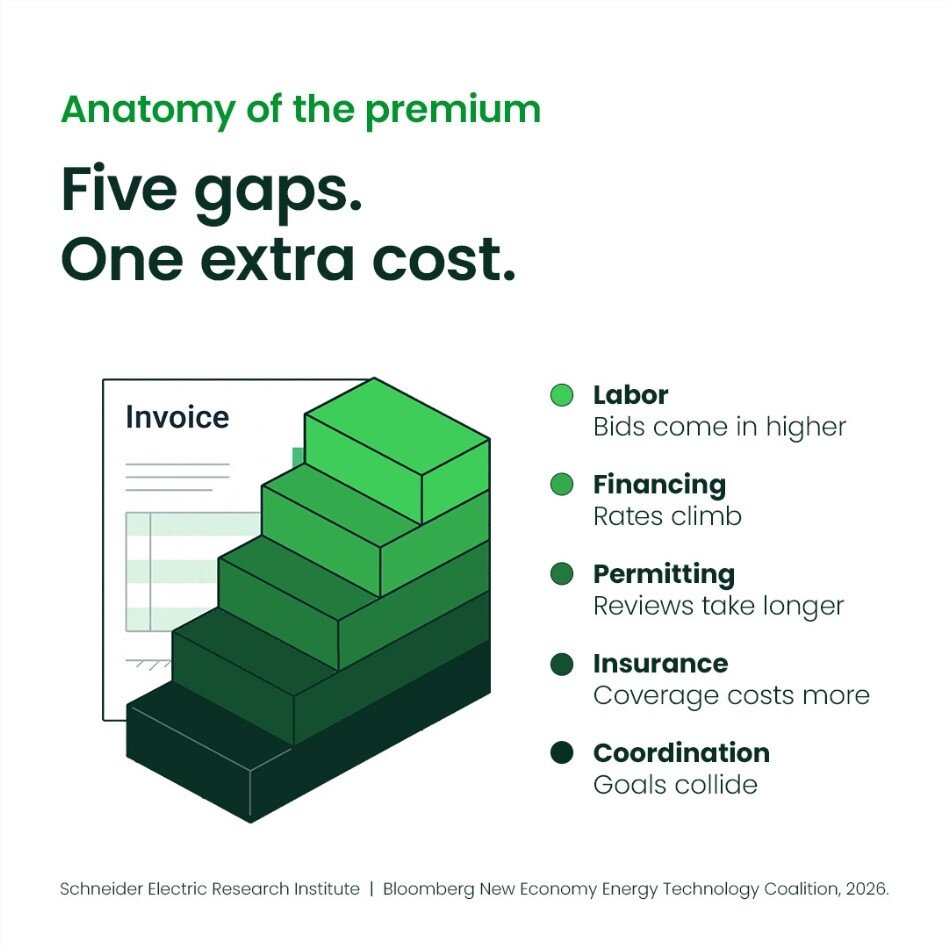
The research breaks the premium into five components, each tied to a known institutional gap.
Labor:
Installers pricing work they’ve never done before.
Financing:
Lenders with no local track record or underwriting template, who price the uncertainty.
Permitting:
Jurisdictions without standard review protocols, which slow projects or approve them without the rigor that protects owners.
Insurance:
Warranty exposure on equipment underwriters haven’t yet seen perform.
Coordination:
Stakeholders who enter a project without aligned goals.
Project invoices don’t separate these components, and procurement processes don’t ask them to. The gap reaches the budget as one number, and the climate-compatible option ends up looking like the imprudent one.
Seattle’s Bullitt Center cost $32.5 million to build. The team later realized they bolted on roughly 60% more rooftop solar than they actually needed. They just had no comparable buildings to calibrate their models against (a classic case of over-engineering out of sheer caution).
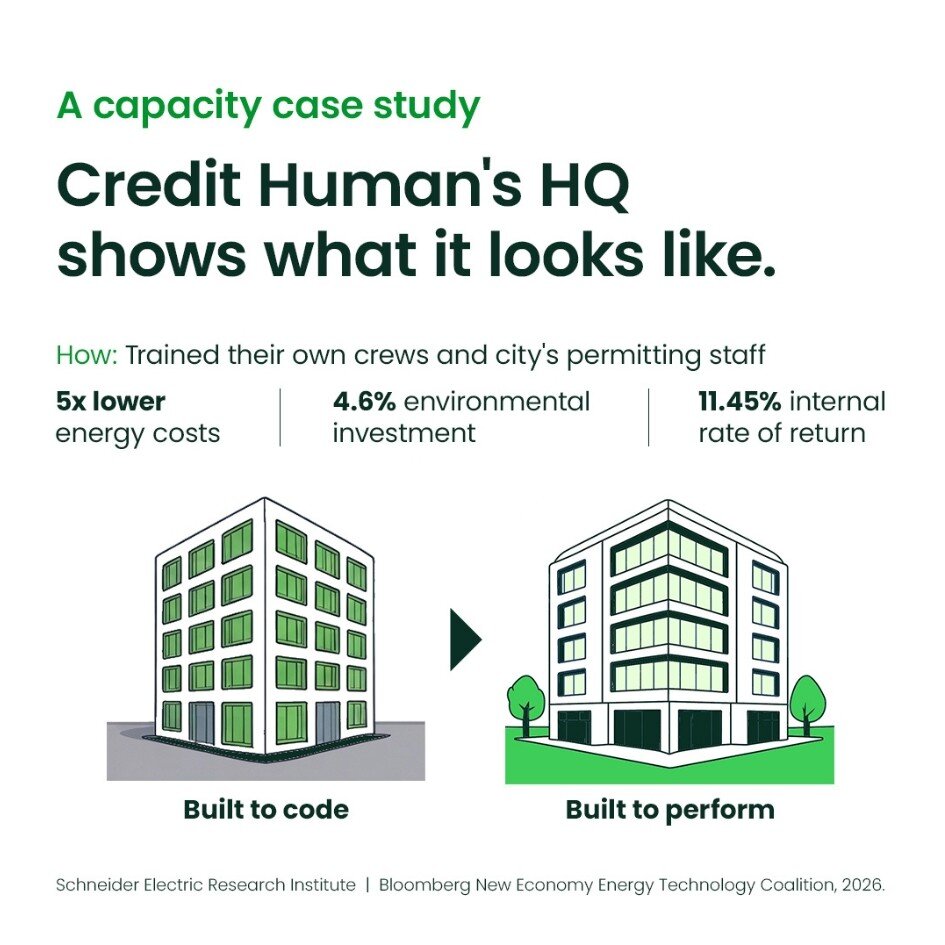
Credit Human, a San Antonio credit union, sits at the other end of the curve. Environmental investments made up 4.6% of its new headquarters’ cost. They ended up with an 11.45% internal rate of return and energy costs five times lower than a normal local building built to code.
The building’s water system separates potable, nonpotable, and reclaimed water. General contractor Joeris sent its plumbers and pipefitters to specialized training, and the City of San Antonio sent its own staff to the same sessions.
Joeris later rehired those trained subcontractors on other jobs. The first building paid part of the learning cost; the next ones inherited the competence.
Modernization relocates risk. A heat pump strips gas leakage and combustion byproducts out of a building and bolts on grid-reliability dependence, refrigerant life-cycle exposure, untested installer competence, and early-retirement capitalexposure.
Across 50 cataloged risks, performance risks appear in 63% of studies and operations risks in 54%. Human capital and social equity risks appear in 17%, because the most-studied risks are the ones with contracts behind them (warranties, metering, OSHA exposure limits).
At a New York City medical college laboratory, a nine- to 12-month project ran past two years because facilities management wasn’t part of the design process. During early testing, some variable air volume boxes turned out to be programmed to zero, producing unsafe ventilation in lab spaces.
The Risk Proximity Spiral maps decarbonization risks by distance from the stakeholder who must act, making deferred and distant harms visible at the design stage. Source: Heinz et al., 2025a.
Concentrating enforcement on the highest-emitting buildings delivers more avoided emissions per dollar, especially where inspection staff and training budgets are thin. One expert interviewed for the research estimated that roughly 4% of buildings produce 40% to 50% of emissions, a practitioner figure consistent with Intergovernmental Panel on Climate Change (IPCC) sectoral analysis.
Boston’s Building Emissions Reduction and Disclosure Ordinance (BERDO), New York City’s Local Law 97, and Washington state’s Clean Buildings Performance Standard all concentrate on the top of the emissions distribution. Local Law 97 sets a 25,000-square-foot floor; BERDO starts at 35,000 square feet in 2025 and drops to 20,000 in 2030.
The U.K. shows what happens when capital moves before capacity does.U.K. Its Green Homes Grant, budgeted to retrofit 600,000 homes, spent about £256 million of a £1.5 billion allocation and improved fewer than 22,000 homes before it was canceled.
"It's going to be cheaper to pay the fines than to do the building updates."
Dale, commercial engineer, Massachusetts
Practitioners in Boston and Phoenix described three futures they fear: green gentrification, cities made more expensive and polluted by construction, and the boondoggle, where technical complexity outruns oversight.
The boondoggle is already visible. One Massachusetts respondent described contractors impersonating municipal officials to sell retrofits. They sent commissioned salespeople door-to-door in lower-income neighborhoods, targeting seniors and residents with limited English proficiency (a pretty bleak look at what happens when funding outpaces oversight).
Workers carry their own exposure here too. California estimates about 1,650 natural gas pipefitters could lose their jobs under current decarbonization pathways.
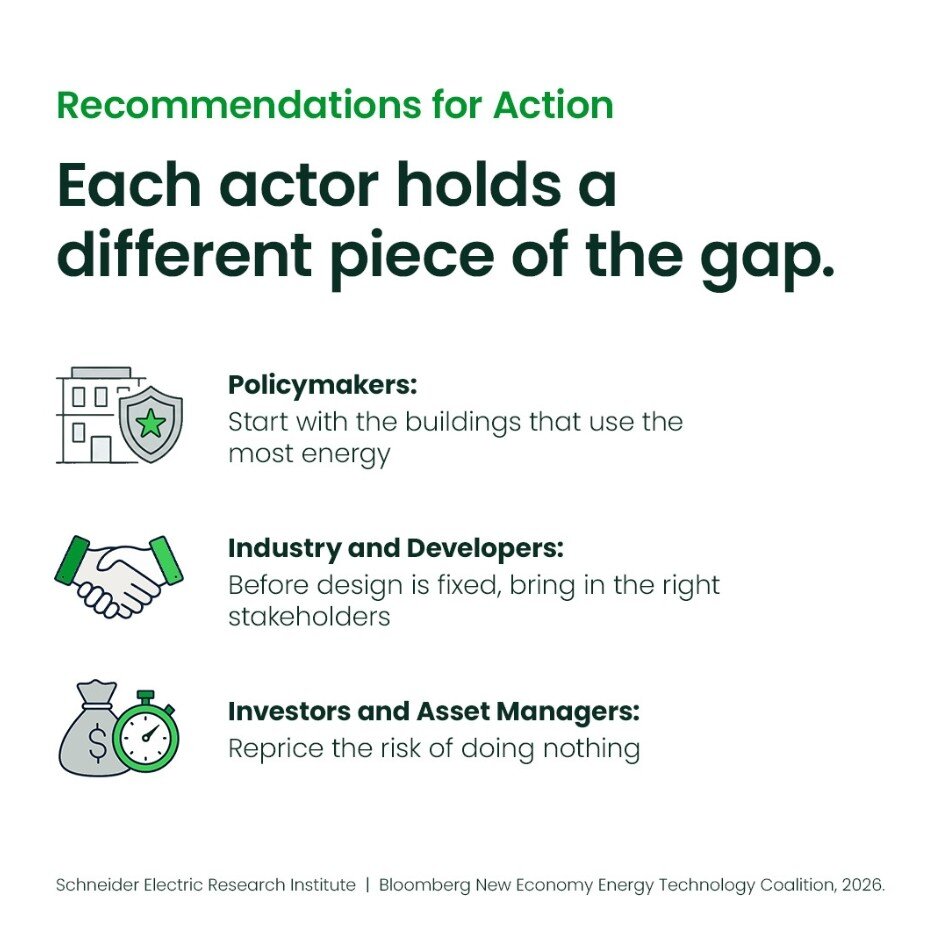
Build capacity before releasing capital. Money that arrives before the installers, review protocols, and underwriting templates exist funds a backlog, and the backlog comes back a budget cycle later priced as hardware.
Policymakers can require performance disclosure for top-emitting buildings, fund workforce programs tied to decarbonization standards, and make anti-displacement provisions a condition of retrofit incentives. In Gainesville, Florida, stricter codes adopted in 2002 were associated with new buildings using 4.27% less electricity and 6.67% less natural gas.
Developers can run a decarbonization risk register at project inception, naming who installs, permits, warranties, maintains, and carries supply-chain risk, and bring facilities management into design decisions.
Investors can stress-test portfolios against performance standard timelines. A commercial boiler installed in 2015 with a 25-year service life becomes a stranded asset five years early in a jurisdiction that mandates electrification by 2035.
Educators and certifiers can add life cycle carbon, environmental product declarations, and anti-displacement policy to core training, and tie credential renewal to measured building performance.
Every piece of capacity that has to come before a falling premium (workforce training, enforcement staff, post-occupancy data, review machinery) costs money before a single building decarbonizes. Someone is already paying, but no one has decided who, so the bill lands on whichever party has the least power to refuse.
Buildings reached this question first because the sector is large, fragmented, and unusually open about its own habits. Steel, ammonia, and grid-scale storage will reach it next, on shorter timelines.
Access our latest report, “Modernizing the Built Environment”, covering risk allocation, the extended carbon lock-in framework, and recommendations for policymakers, developers, investors, and educators.

Latest from Schneider Electric Research Institute
Powering sustainable AI in the United States
Beyond grid dependency: Technical and economic case for new energy systems in green steel
Copper dynamics and horizons: Building sector mitigation and electric vehicle-driven growth
United States water infrastructure: From fixing leaks to regenerating the system

Need help?
Product Selector
Quickly and easily find the right products and accessories for your applications.
Get a Quote
Start your sales inquiry online and an expert will connect with you.
Where to buy?
Easily find the nearest Schneider Electric distributor in your location.
Help Center
Find support resources for all your needs, in one place.